
Landmark
Stari Most
Mostar · Herzegovina
QUICK INFORMATION
- CATEGORY
- Landmark
- COUNTRY
- Bosnia & Herzegovina
- REGION
- Mostar · Herzegovina
- DURATION
- 1–2 days
ABOUT THIS ATTRACTION
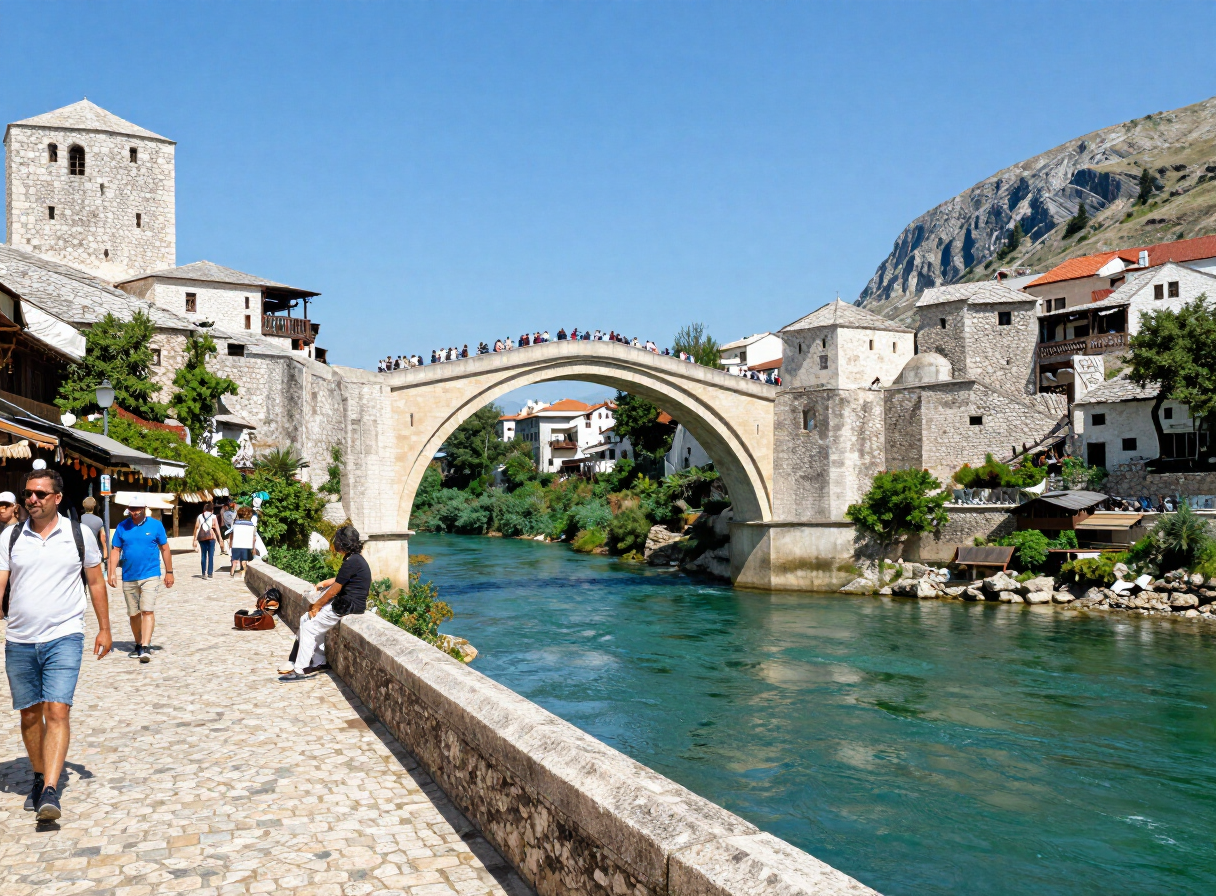
Stari Most — the Old Bridge — is the slender stone arch that gives Mostar its name and its reason for being. Commissioned by Suleiman the Magnificent and completed in the 1560s, it leaps the Neretva in a single 29-metre span, rising to an apex some twenty metres above the cold emerald river. For four centuries it was the most audacious bridge in the Balkans, and the town that grew around it took its identity from it: Mostar means “the place of the bridge-keepers.” Destroyed in the war in November 1993 and rebuilt with stone lifted from the riverbed, it reopened in 2004 and now stands at the heart of a UNESCO World Heritage Site — at once an Ottoman engineering marvel, a symbol of a divided city’s reconciliation, and the stage for the divers who still leap from its crest each summer.
HISTORY & BACKGROUND
The story behind it
Before the stone bridge, a wooden suspension span crossed the Neretva at this point, and the settlement on its banks was already known for its mostari — the keepers who watched the crossing. In the 1560s the Ottoman court ordered a permanent bridge, and the work is traditionally attributed to the architect Mimar Hayruddin, a pupil of the great Sinan. Legend says he was given three days to raise the scaffold or be killed; when the supports were finally removed, the arch held. The result was a single hump of pale local limestone, barely two metres wide at the crest, with no railing — a bridge that demanded a steady nerve from anyone crossing it in winter ice or wind. It stood for 427 years. On 9 November 1993, during the siege of the city, the bridge collapsed into the Neretva under shelling. The loss was felt far beyond Mostar: it had joined a Muslim quarter on the east bank to a Croat one on the west, and its fall became the war’s most iconic image of cultural destruction. An international reconstruction project recovered hundreds of original stone blocks from the riverbed, cut replacements from the same quarry, and reopened the bridge in July 2004. In 2005 the old bridge area was inscribed on the UNESCO World Heritage List.
WHAT TO SEE
What to see here
The arch itself — stand at either end and look along the curve of pale tenelija limestone, rising to a sharp crest with no parapet, exactly as it was built in the 1560s.
The two flanking towers: the 15th-century Tara (Herceguša) tower on the west bank and the Halebija tower on the east, which once guarded the toll crossing and now frame the bridge in every photograph.
The divers — from late spring through early autumn, members of the Mostari diving club climb to the apex and leap into the Neretva, continuing a tradition documented for generations. A donation is customary; watch from the riverbank or the bridge itself.
The Neretva gorge — the bridge sits in a narrow limestone canyon; look down at the emerald water and upstream toward the hills that close the old town.
WHY IT MATTERS
Why it matters
Few single structures carry the weight that Stari Most carries. It is an Ottoman engineering achievement — one of the widest stone arches of its era — and the architectural soul of a city. But its meaning runs deeper. For centuries it joined two communities on opposite banks, and its deliberate destruction in 1993 was understood, in Bosnia and beyond, as an attempt to sever that connection. Its reconstruction, using original stone returned to the riverbed, was therefore never only a building project: it was an act of repair. To stand on the crest today is to stand on a bridge that has been broken and put back — a place where engineering, memory and reconciliation meet in a single span of stone.
PRACTICAL INFORMATION
Before you go
THROUGH THE LENS
From the road


MAP & LOCATION
Stari Most
Stari Most, Mostar, Herzegovina, Bosnia & Herzegovina
43.3438, 17.8078
MORE ATTRACTIONS
More to see in Mostar


FOOD & DRINK
Where to eat nearby
Hindin Han — traditional Herzegovinian dishes beside a rushing creek
Šadrvan — classic ćevapi and begova čorba right on the bazaar
Tima-Irma — legendary mixed grill plates, beloved by locals
HOTELS & STAYS
Where to stay nearby
Hotel Mepas — modern comfort and a pool in the city centre
Pansion Nur — family-run, steps from the Old Bridge
Hostel Miran — a social, budget-friendly base for backpackers
ITINERARIES
Day-by-day routes
NEARBY DESTINATIONS
Continue the journey


ROUTES
Routes through here
Mostar to Sarajevo via the Neretva Canyon
A classic Balkan ride north up the Neretva canyon — river, cliffs and forest from Mostar to Sarajevo.
130 km · 3 h · moderate
VIEW ROUTEBogodol–Velika Vlajna Summit Route
A demanding out-and-back ascent from Bogodol to Velika Vlajna, the high point of the bare Čabulja massif northwest of Mostar.
12.1 km · 4.8 h · challenging
VIEW ROUTEPART OF
Keep exploring
The atlas goes on — more attractions, destinations and stories from every corner of the world.