
QUICK INFORMATION
- DURATION
- 1 day
- COUNTRY
- Bosnia & Herzegovina
- REGION
- Travnik · Central Bosnia
- CATEGORY
- Cities & Culture
ABOUT THIS ITINERARY
Travnik is a town made for a single day, because its whole character fits into one short, walkable loop. The fortress stands on the hill at one end, the blue Plava Voda spring at the foot of that hill, and between them run the old bazaar street, the painted Šarena Džamija and the birth house of Ivo Andrić — all within a few minutes of one another. This itinerary threads them into one relaxed route: the citadel where the Ottoman viziers held the province, the painted mosque that distinguishes Travnik from every other Bosnian town, the writer’s birth house on the bazaar street, a long ćevapi lunch, and a slow afternoon beside the blue spring. Nothing needs rushing; the times are guidance, and the day leaves room for coffee, wandering and sitting by the water.
OVERVIEW
The route at a glance
The route follows the grain of the town rather than a checklist. You begin at the fortress, climbing the short steep path to the gate of Stari Grad for the view over the rooftops, minarets and the Lašva valley, then descend into the old centre and onto the bazaar street. A short distance along it stands the Šarena Džamija, the painted mosque whose interior walls and dome are covered in bright floral and landscape decoration, and close by the birth house of Ivo Andrić, now a small memorial museum to the Nobel-laureate writer. A ćevapi lunch on the bazaar street is the natural midday pause, after which a few minutes’ walk west brings the blue Plava Voda spring and its green park at the foot of the fortress hill — the calm close of the loop.
The whole route is on foot and compact, with only the brief steep climb to the fortress. One optional stop is marked for visitors who prefer a single authored loop narrative of the town rather than the stop-by-stop route, but the core itinerary stands without it.
THE SCHEDULE
Day by day
Travnik in One Day
A walkable loop through the centre — the Stari Grad fortress, the painted Šarena Džamija, the Ivo Andrić Memorial Museum, a ćevapi lunch on the bazaar street, and a slow afternoon at the blue Plava Voda spring.
- 08:30
Begin at Travnik Fortress
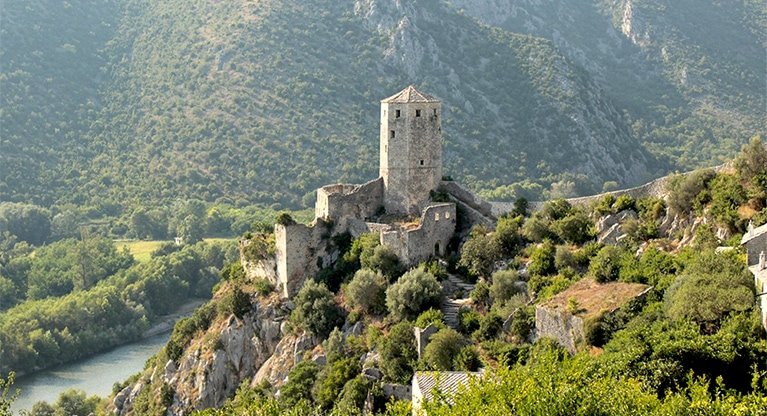
45–60 minStart early, before the centre fills. The Travnik Fortress — Stari Grad — is the medieval citadel that crowns the steep hill at the western edge of the town, and the reason Travnik sits where it does. Climb the short steep path to the gate, walk the curtain walls and towers, and take in the view over the Ottoman town below and the Lašva valley to the mountains beyond. The fortress houses a small museum on its vizier-town years; check locally for opening hours and any admission fee. From the ramparts the whole layout of Travnik reads at a glance, which is why it is the natural starting point.
- 10:00
The Šarena Džamija
45 minDescend into the old centre to the Šarena Džamija — the “coloured” or painted mosque, formally the Sulejmanija — the one building every visitor to Travnik comes to see. From the outside it is a small, neat Ottoman mosque with a minaret and a stone-walled courtyard; from the inside it is a surprise, the walls, dome, gallery and porch ceiling covered in painted floral and landscape decoration in bright colours. A small museum beside it tells the story of the mosque and the Travnik muftiluk. Non-Muslim visitors are welcome outside prayer times; dress modestly (shoulders and knees covered, scarves usually provided) and avoid the Friday midday prayer.
- 11:00
The Ivo Andrić Memorial Museum
45 minA short walk along the bazaar street brings the birth house of Ivo Andrić, the writer who won the Nobel Prize for Literature in 1961, preserved and opened as a small memorial museum. Displays cover Andrić’s life, his Nobel Prize and the Travnik he wrote about in “Travnik Chronicle,” the novel that fixed the town’s Ottoman vizier years onto the page. It is the literary layer of the town, where the real Travnik and the Travnik of the novel meet. Opening hours are limited, so confirm before a dedicated visit; allow a short, focused stop.
- 12:30
Ćevapi lunch on the bazaar street
1 hourPause for the dish the town is famous for. Travnik is one of the great ćevapi towns of Bosnia, and the simple ćevabdžinicas on and around the bazaar street specialise in small grilled fingers of minced meat served in somun bread with raw onion and kajmak, the clotted cream that marks a Travnik portion. Order by the portion, ask for kajmak, and round it out with a soup or a slice of pie and a Bosnian coffee to finish. Most ćevabdžinicas open for lunch and close in the evening, so ćevapi is best as a midday meal; expect a short wait at weekend lunchtimes.
- 14:00
Plava Voda
1–2 hoursFinish at the blue spring. A few minutes’ walk west brings Plava Voda — the “blue water” — a strong karst spring that rises a deep, improbable blue from a rocky basin at the foot of the fortress hill, feeding a stream that runs through a green park of trees, paths and cafés. Walk the channel of cold, clear water, sit beneath the trees, and read the spring against the citadel visible above. It is the natural rest point of a visit — the easy, watery counterpoint to the hard military layer of the fortress — and the calm close of the loop. The park is public and open at all times.
Optional stops
A single authored loop of the fortress, old town and historic centre
MorningVisitors who prefer to follow one self-guided narrative rather than the stop-by-stop route can take this authored walking loop instead: it climbs to the fortress for the valley view, descends through the bazaar street to the painted Šarena Džamija and the Ivo Andrić house, and finishes at Plava Voda. It covers the same ground as the morning stops in a single continuous walk, and it needs no booking, no transport and no plan beyond a few hours. Skip it if the stop-by-stop route already feels complete; the core itinerary stands without it.
GETTING AROUND
The whole route is on foot and compact — no stop is more than a few minutes’ walk from another, except the short steep climb to the fortress. Wear comfortable walking shoes with grip for the cobbled approach and the ramparts. No transport is needed within the town; taxis serve the wider area for travellers combining Travnik with Jajce or Sarajevo.
EAT & DRINK
Begin with a light breakfast at your accommodation or a café on the bazaar street. The ćevapi lunch is the food layer of the day — order by the portion with kajmak, and finish with a Bosnian coffee. For the evening, the bazaar street and the lanes around Plava Voda stay open after the afternoon pause; eat after the spring rather than rushing away.
SEASONAL NOTES
When to go
Summer days (July and August) are warm, so treat the slowest hours around midday as a coffee-and-shade pause and save the Plava Voda park for the cooler afternoon. April to June and September to October give the most comfortable walking weather, the greenest park and softer light over the valley from the fortress. Daylight varies widely through the year, so check the sunset time for the day you visit rather than relying on a fixed hour. The fortress museum and the Andrić Memorial Museum keep limited hours, so confirm locally before a dedicated visit; the mosque, the bazaar street and Plava Voda are walkable year-round.
PRACTICAL INFORMATION
Before you go
THROUGH THE LENS
From the road


THE ROUTE ON THE MAP
Stops on the map
ATTRACTIONS ON THIS ROUTE
Sights on the way
EXPERIENCES ON THIS ROUTE
Things to do along the route

MORE ITINERARIES
Other routes from Travnik
FOOD & DRINK
Where to eat nearby
Ćevabdžinicas on and around the bazaar street — Travnik ćevapi with kajmak, the dish the town is famous for
Old-town bakeries for burek and sirnica, and cafés for Bosnian coffee after a meal
HOTELS & STAYS
Where to stay nearby
Small central guesthouses and hotels in the old town — a convenient base for a one-day visit
Nearby Jajce and Vitez for travellers combining Central Bosnia in a single trip
NEARBY DESTINATIONS
Continue the journey


INTERESTS
Explore by what you love
PART OF
Keep exploring
The atlas goes on — more attractions, destinations and stories from every corner of the world.