
QUICK INFORMATION
- DURATION
- 1 day
- COUNTRY
- Bosnia & Herzegovina
- REGION
- Jajce · Central Bosnia
- CATEGORY
- History & Heritage
ABOUT THIS ITINERARY
Jajce rewards a single day because almost everything that matters sits within a short, steep walk of the fortress, with only the upstream lakes needing transport. This itinerary threads the town’s layers into one morning — the citadel where the last kings of Bosnia were crowned, the Roman sanctuary and the medieval catacombs carved into the rock beneath the streets, and the Pliva Waterfall plunging into the Vrbas at the foot of the gorge — before stepping upstream to the turquoise Pliva lakes and the old wooden watermills at Mlinčići for a calm afternoon on the same river. Nothing needs rushing; the times are guidance, and the day leaves room for coffee in the old town and a long pause beside the water.
OVERVIEW
The route at a glance
The day follows the geography of the town rather than a checklist. You begin at the top, at the fortress where the ramparts open the clearest single view over the two rivers, the waterfall and the old town, then descend through the historic core to the underground Temple of Mithras and the medieval catacombs carved into the rock beneath the streets. The morning closes at the lip of the gorge, where the Pliva Waterfall drops twenty-one metres into the Vrbas — the sight that defines Jajce. After a midday pause in the centre, the route leaves town for the short drive upstream to the Pliva lakes and the wooden watermills at Mlinčići, where the same river runs flat, green and calm among the mills and footbridges.
The whole morning is on foot and steep in places; the afternoon needs a car, taxi or bike for the short run upstream to the lakes. One optional stop is marked for visitors who prefer a single authored loop narrative of the morning rather than the stop-by-stop route, but the core itinerary stands without it.
THE SCHEDULE
Day by day
Jajce in One Day
A steep morning through the fortress, the underground Temple of Mithras and catacombs and the Pliva Waterfall, followed by an afternoon among the turquoise Pliva lakes and wooden watermills at Mlinčići.
- 08:30
Begin at Jajce Fortress
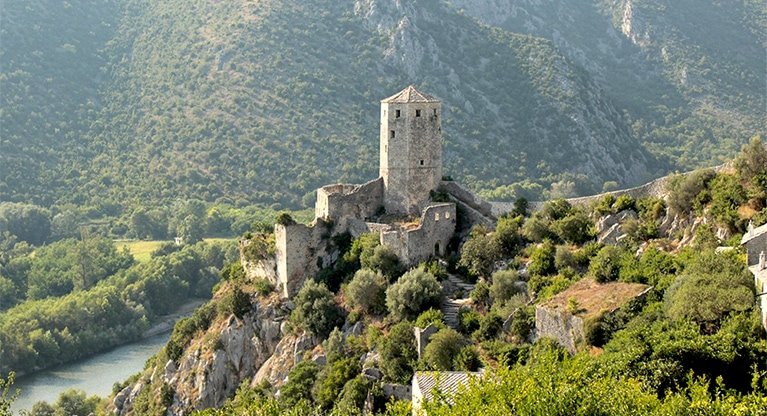
45–60 minStart early, before the centre fills. The fortress crowns the height above the confluence of the Pliva and the Vrbas, and it is the oldest built part of Jajce — the stronghold around which the medieval town grew and the seat where the last kings of Bosnia were crowned. Climb to the ramparts for the clearest single overview of the town: the two rivers, the waterfall below, the old town spilling down the hill and the mountains closing the horizon. Read the Bear Tower with its carved royal coat of arms, then descend into the old town. Wear flat, grippy shoes; the approach is steep and cobbled.
- 09:45
Temple of Mithras
30 minA short descent from the streets above brings you into the rock-cut Temple of Mithras, a small underground Roman sanctuary dedicated to the mystery god Mithras. The centrepiece is the carved Tauroctony relief — Mithras slaying the bull — set into the end wall of the dim chamber. It is the deepest historical layer in Jajce, older than the fortress or the Ottoman town, and the contrast between the ordinary town at the surface and the rock-cut sanctuary below is part of the visit. Opening hours are limited and a small fee may apply, so check access locally; wear flat shoes for the steps and the uneven rock floor.
- 10:30
Jajce Catacombs
30 minA short walk away, the catacombs are a medieval underground church and burial complex carved directly into the rock beneath the old town, attributed to Duke Hrvoje Vukčić Hrvatinić, the 15th-century lord who made Jajce his capital. The rock-cut chambers and passages survive with carved decoration, and the site ties the town directly to its 15th-century golden age. Pair it with the Temple of Mithras for the underground-and-above reading of Jajce. Access is by steps into uneven rock, and hours are limited, so check locally or through the museum.
- 11:30
The Pliva Waterfall
45–60 minDescend to the lip of the gorge for the climax of the morning: the Pliva river pouring over a limestone lip and falling some twenty-one metres into the Vrbas, right in the centre of the town. Read the fall from the lower viewpoint near the confluence, where you stand at the meeting of the two rivers and look up at the Pliva coming down with the fortress above it, then take in the upper viewpoint near the lip for a top-down sense of the water leaving the Pliva. The path down is steep and the stone is wet and slippery, so wear shoes with grip. A small entrance fee is charged for the lower platform; bring cash (BAM).
- 13:30
The Pliva lakes and watermills at Mlinčići
2–3 hoursAfter a midday pause in the centre, drive or take a taxi (or ride a bike along the lakeside road) a few kilometres upstream to Mlinčići, where the Pliva widens into a chain of clear turquoise lakes and a row of old wooden watermills stands directly on the water. Walk out among the mills on the wooden footbridges, look into the working grindstones where grain is still milled in season, and take in the signature reflected view. In summer you can swim from the designated spots or rent a kayak on the cold, spring-fed water. It is the gentle, photogenic counterpoint to the steep gorge and fortress downstream, and the natural way to slow down after the morning loop.
Optional stops
A single authored loop of the fortress, old town and waterfall
MorningVisitors who prefer to follow one self-guided narrative rather than the stop-by-stop route can take this authored walking loop instead: it begins at the fortress and descends through the old town, past the gates and the Bear Tower, with detours into the underground Temple of Mithras and the catacombs, to end at the Pliva Waterfall viewpoint in the gorge. It covers the same ground as the morning stops in a single continuous walk, and it is the one experience that needs no planning, no booking and no guide. Skip it if the stop-by-stop morning already feels complete; the core itinerary stands without it.
GETTING AROUND
The morning is entirely on foot within the old town, but it is steep in places — the fortress is at the top of the hill and the waterfall at the bottom of the gorge, with the underground sites reached by steps. Wear flat, grippy shoes for the cobbles and the wet stone around the fall. The afternoon needs a car, taxi or bike for the short run upstream to the Pliva lakes and watermills at Mlinčići; parking is available beside the mills.
EAT & DRINK
Begin with a light breakfast at your accommodation or a café in the old town. Plan lunch in the centre after the morning loop — the lanes near the waterfall and the old core have everyday Bosnian options, and a coffee on the square can stand in for a formal break. The lakeside at Mlinčići has cafés and a restaurant beside the water, a good place for a long afternoon pause. Eat in the old town after returning from the lakes rather than rushing away.
SEASONAL NOTES
When to go
Summer days (July and August) are warm, so treat the slowest hours around midday as a coffee-and-shade pause and save the lakeside afternoon for the cooler part of the day. May to June and September to October give the most comfortable walking weather, and the waterfall is at its most powerful in spring after snowmelt and rain, when the Pliva runs fullest. Daylight varies widely through the year, so check the sunset time for the day you visit rather than relying on a fixed hour. The underground Temple of Mithras and catacombs are sheltered and visitable year-round, but their opening hours are limited, so confirm access locally before a dedicated visit.
PRACTICAL INFORMATION
Before you go
THROUGH THE LENS
From the road


THE ROUTE ON THE MAP
Stops on the map
ATTRACTIONS ON THIS ROUTE
Sights on the way


EXPERIENCES ON THIS ROUTE
Things to do along the route
MORE ITINERARIES
Other routes from Jajce
FOOD & DRINK
Where to eat nearby
Restoran Pliva — trout from the lakes, grilled simply
Kod Asima — hearty Bosnian classics near the waterfall
HOTELS & STAYS
Where to stay nearby
Hotel Stari Grad — comfortable base inside the old town
Pliva Lakes bungalows — wake up on the water
NEARBY DESTINATIONS
Continue the journey


INTERESTS
Explore by what you love
PART OF
Keep exploring
The atlas goes on — more attractions, destinations and stories from every corner of the world.