
MAGAZINE STORY · Road Trips
Trebinje and Southern Herzegovina — Stone, Wine and Karst
A journey through Trebinje, Vjetrenica Cave and Stolac — river towns, Ottoman bridges, underground biodiversity and layers of Herzegovinian history.
THE STORY
A journey through Trebinje, Vjetrenica Cave and Stolac — river towns, Ottoman bridges, underground biodiversity and layers of Herzegovinian history.
- Published
- September 24, 2026
- Read time
- 8 min read
Begin beside the Trebišnjica in Trebinje
Trebinje is a southern Herzegovinian river town built at a slower scale than the region’s better-known cities. The Trebišnjica runs past the old centre beneath plane trees and stone bridges, while the hills rise quickly behind the rooftops. The compact Kastel old town, the riverbank and the market square form a natural walking circuit, and the city works best when approached as a place to pause rather than a list of monuments to complete.
The old quarter preserves the Ottoman layer of the city in its street pattern, walls and religious buildings, while later civic architecture spreads beyond the gates. From the opposite bank, the relationship between the walled centre and the river becomes clear: Trebinje grew around water, crossings and the routes connecting the Adriatic hinterland with inland Herzegovina.
Begin on foot and leave the car parked while exploring the centre. The riverbank is the orientation line, the old town supplies the historic core, and the shaded public spaces explain why Trebinje feels as much like a place to inhabit as a place to visit.
Read the city through Arslanagić Bridge
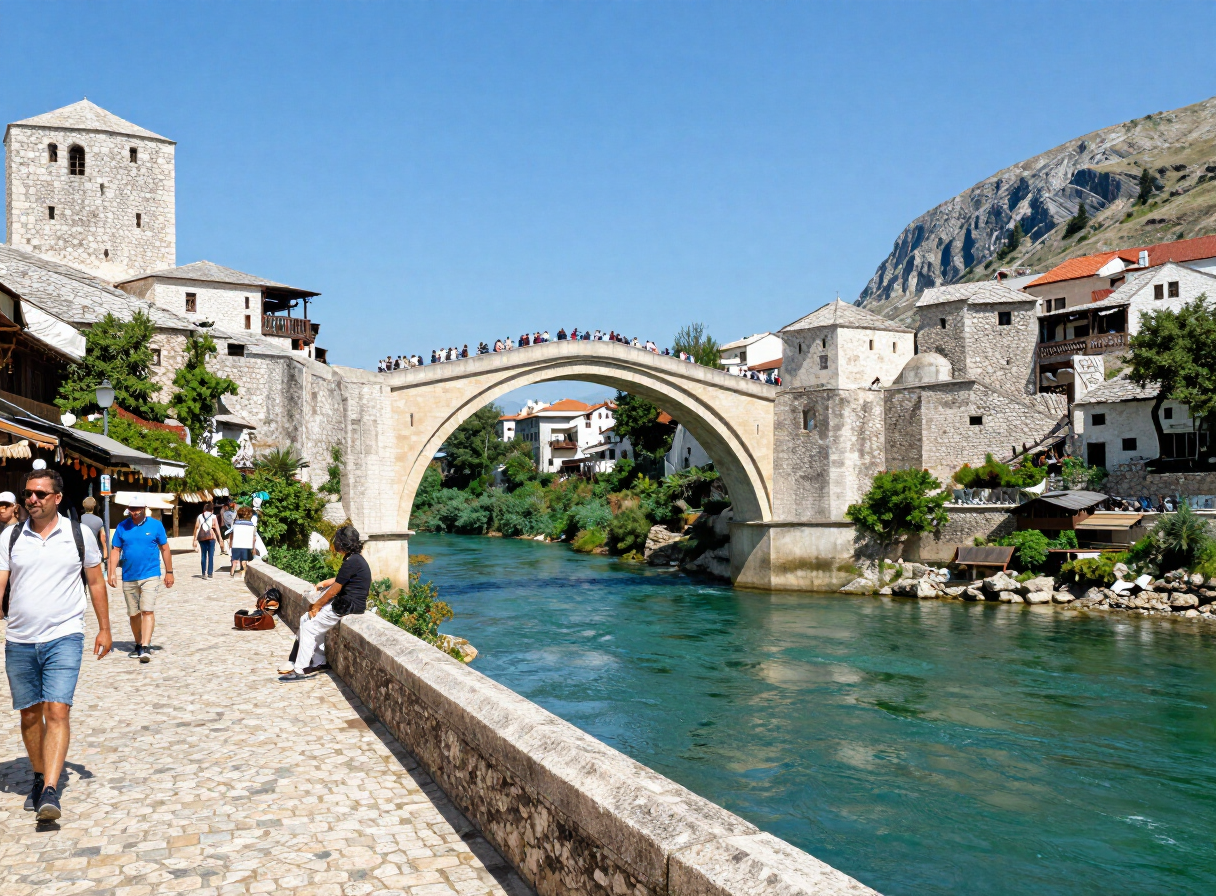
Arslanagić Bridge is Trebinje’s defining historic crossing. Built in 1574 as an Ottoman endowment, it once stood farther downstream on an important trading route. The construction of a hydroelectric reservoir submerged its original setting in the 1960s, after which the bridge was dismantled and reconstructed closer to the city. Its present location is therefore part of its history rather than the place for which it was first designed.
Walk to the bridge along the Trebišnjica and view it from both banks. The low stone arches, the broad river and the surrounding hills create one of the clearest compositions in the city, but the value of the bridge goes beyond the photograph. It records the Ottoman road network, the transformation of the river in the twentieth century and the deliberate decision to preserve a monument by moving it.
The bridge and Kastel belong to the same city walk, but they tell different stories. The old town explains Trebinje as a settled urban centre; the bridge explains it as a crossing point between coast, mountains and inland valleys.
Follow the monastery and vineyard landscape
Outside the centre, the cultural landscape opens into vineyards, karst hills and religious sites. Tvrdoš Monastery stands west of the city above the Trebišnjica valley and is both an active Serbian Orthodox monastery and part of the long wine tradition of the area. Hercegovačka Gračanica occupies the opposite kind of setting, high above Trebinje, where the panorama reveals the river, the city and the dry limestone country around them.
Wine is part of the region’s agricultural identity, but a visit does not require promotional winery touring. The useful context is the landscape itself: vines planted in karst soil, monasteries and villages connected by the valley roads, and a climate that differs sharply from the higher country to the north. If visiting a monastery or tasting room, check current access directly, dress respectfully and treat wine tasting as optional rather than the centre of the journey.
Together, the hilltop viewpoint and the monastery valley widen Trebinje beyond the old town. They show how the city belongs to a larger southern Herzegovinian landscape shaped by faith, agriculture, stone and water.
Enter the karst world at Vjetrenica Cave
West of Trebinje, Popovo Polje introduces the underground geography of Herzegovina. Water disappears into limestone, seasonal flows cross the karst field and caves carry ecosystems that are mostly invisible from the road. Vjetrenica Cave near Zavala is the most important expression of that landscape and was inscribed on the UNESCO World Heritage List in 2024 for its exceptional subterranean biodiversity and endemic cave fauna.
The cave is not simply a chamber of decorative formations. Its significance lies in a living underground system of passages, streams, pools and species adapted to darkness. The cool wind at the entrance gave Vjetrenica its name, while scientific research established the cave as one of the world’s important centres of subterranean biodiversity. A visitor tour reveals only part of a much larger protected system.
Treat the cave as a managed natural site. Use the official guided access, remain on the visitor route and confirm current opening arrangements before travelling. Zavala Monastery and the stećci above the cave belong to the wider cultural landscape, but they are not part of the UNESCO-inscribed natural property and should be understood as separate nearby heritage sites.
Continue west to the layered town of Stolac
Stolac adds another historical layer to a southern Herzegovina journey. The Bregava flows through an old town of bridges, mills and stone houses beneath Vidoški Castle, while the nearby Radimlja necropolis preserves one of the region’s most important groups of medieval stećci tombstones. Radimlja is a component of the UNESCO-inscribed serial property “Stećci Medieval Tombstone Graveyards”; the wider town is a separate historic ensemble.
The value of Stolac is the density of periods within a small landscape: prehistoric and Illyrian archaeology in the wider area, medieval fortification and tombstones, and Ottoman streets along the Bregava. Walk the river and old town at ground level before climbing toward the fortress, and visit Radimlja as a focused heritage stop rather than treating the carved stones as roadside decoration.
Trebinje, Vjetrenica and Stolac should not be reduced to a race between highlights. Together they reveal the southern part of Herzegovina through three different settings: a lived-in river city, a protected underground ecosystem and a town where archaeological and architectural layers remain visible beside the water.
Plan the journey as a sequence of landscapes
The strongest route through southern Herzegovina follows changes in landscape rather than a checklist. Trebinje provides the urban base, Popovo Polje and Vjetrenica introduce the karst system, and Stolac closes the journey with river, fortress and medieval heritage. Allow the route to expand or contract around current access, weather and the pace of the road.
- Begin in Trebinje — walk the old town, riverbank and Arslanagić Bridge before driving into the wider region.
- Separate monuments from living places — monasteries remain active religious sites, and ordinary neighbourhoods are not visitor exhibits.
- Confirm Vjetrenica access — use the official guided visitor route and check current opening arrangements before travelling.
- Treat Radimlja carefully — remain within the marked visitor area and respect the medieval tombstones as protected heritage.
- Keep the route flexible — summer heat, cave access, road conditions and seasonal daylight can change the practical order of the journey.
Practical notes for southern Herzegovina
- Suggested time
- Several days allow Trebinje, Vjetrenica and Stolac to be experienced as distinct places rather than compressed into quick photo stops.
- Best season
- Spring and autumn bring milder conditions for old-town and fortress walks; summer can be very hot, while cave access and opening arrangements should always be checked directly.
- Getting around
- Trebinje is walkable in its centre, but a private vehicle or arranged transport is the practical way to connect the city with Vjetrenica, Popovo Polje and Stolac.
- Responsible travel
- Respect active religious sites, protected cave rules and marked heritage areas, and confirm current access rather than relying on old schedules.
THROUGH THE LENS
From the road


RELATED DESTINATIONS
Places in this story
Trebinje
Plane trees, wine and stone bridges in the sunny south.
Herzegovina

Vjetrenica Cave
The wind cave of Popovo Polje — an exceptionally biodiverse karst cave and a UNESCO World Heritage Site in the karst of Herzegovina.
Herzegovina

Stolac
A heritage town in the Herzegovina karst — a hilltop fortress, a UNESCO stećci necropolis and an old stone quarter on the Bregava river.
Herzegovina
ATTRACTIONS IN THIS STORY
16 attractions
Old Town and Kastel
The walled old core of Trebinje, built on medieval foundations and enlarged by the Ottomans, sitting between the Trebišnjica and a spring-fed creek. Its ramparts, gates and quiet lanes are the oldest part of the town and the place to begin a visit.
Arslanagić Bridge
A graceful 16th-century Ottoman stone bridge with two arches and a humpbacked profile, originally built over the Trebišnjica upstream of the town and moved stone by stone in the 1970s to save it from a hydroelectric reservoir. It now stands just downstream of the centre and is Trebinje’s most elegant single monument.
Hercegovačka Gračanica
A white Serbian Orthodox church and monastery built on the hill above Trebinje in the late 1990s, modeled on the medieval Gračanica monastery in Kosovo. Its terraces give the finest panorama over the town, the Trebišnjica and the plain — the place most locals come to watch the sun set.
Tvrdoš Monastery
A medieval Serbian Orthodox monastery set in a vineyard-covered valley beside the Trebišnjica, a few kilometres upstream of Trebinje. The seat of the Zahumlje and Herzegovina diocese, it is best known today for its working wine cellars, where monks produce the Žilavka and Vranac wines that have made the Trebinje region famous.
Museum of Herzegovina Trebinje
The Museum of Herzegovina in Trebinje, founded in 1952, holds the archaeological, ethnographic, historical and art collections that trace the town and its region — an institution whose origins lie in the idea and personal collection of the Trebinje-born poet and diplomat Jovan Dučić.
Freedom Square and Platani
Trg slobode — Freedom Square — is the main public square of Trebinje, shaded by a line of mature plane trees whose canopy is the most loved feature of the town centre and the setting for its everyday public life.
Osman Pasha Mosque
The Osman-pasha Mosque, built in 1726 inside the walls of Kastel, is the endowment of Osman-pasha Resulbegović — a finely cut stone mosque with an octagonal minaret and one of the principal Ottoman monuments of the old town.
Trebinje Cathedrals and Sacred Heritage
A combined, neutral record of the two cathedrals that stand in the central townscape of Trebinje — the Serbian Orthodox Cathedral of the Holy Transfiguration and the Roman Catholic Cathedral of the Nativity of Mary — read together as part of the town’s late-19th and early-20th-century civic and religious architecture.
THINGS TO DO
Experiences Not to Miss
Walk Trebinje’s old town and the Trebišnjica river
Taste the wines of the Trebinje vineyards
Discover Trebinje museum and literary heritage
Photograph Trebinje from river to hillside
Duži Monastery and Trebinje Countryside Visit
Take a guided tour of Vjetrenica Cave with a park guide
Visit Zavala monastery and the stećci necropolis above the cave
Drive the Popovo Polje karst field toward Ravno and Trebinje
INTERESTS
Explore by what you love
MORE TO EXPLORE
Keep exploring
The road goes on — more destinations, stories and road trips from every corner of the world.