MAGAZINE STORY · Travel
A Day in Sarajevo — History, Coffee and Hidden Corners
From dawn coffee in Baščaršija to sunset on the Yellow Bastion — how to spend one perfect day in the capital.
THE STORY
From dawn coffee in Baščaršija to sunset on the Yellow Bastion — how to spend one perfect day in the capital.
- Published
- May 12, 2025
- Read time
- 7 min read
Begin the day in Baščaršija
Sarajevo is a city you feel before you understand it, and the place to begin feeling it is Baščaršija, the Ottoman old bazaar that has traded in much the same way since the 15th century. At its centre stands the Sebilj, the carved wooden fountain that has become the postcard image of the city and the natural meeting point for everyone who passes through. Arrive early, before the day-trippers, and the lanes are at their quietest: the call to prayer, the smell of ćevapi and roasted coffee, and the slow rhythm of a bazaar that was already old when the Habsburgs arrived.
The quarter grew through the 16th century under Gazi Husrev-beg, whose endowments built the mosque, the bezistan, the library and the hammams that still anchor the area, and the craft streets still organised by the Ottoman guild system are the reason a walk here reads like a living museum. Kazandžiluk, the coppersmiths’ lane, is the best of them: copper coffee sets and trays hammered by hand in low workshops, the sound of the work carrying into the street. Stop for bosanska kafa in one of the cafés around the Sebilj — the ritual of coffee is the social spine of the city, and the morning is when it is at its most unhurried.
Give the morning two or three hours. The Gazi Husrev-beg Mosque, the bezistans and the small museums of the quarter are all within a few minutes’ walk of the Sebilj, and the lanes are cobbled, so wear shoes with grip. The bazaar is a public quarter open at all hours, but the craftsmen work during the day, and the morning is when you can watch them.
Walk along the Miljacka
From Baščaršija, walk west toward the Miljacka, the river that threads the valley, and the city’s layers begin to read in sequence. Within a few blocks the Ottoman east gives way to the Austro-Hungarian grid of central Sarajevo — a deliberate contrast that is one of the most distinctive things about the capital, and one you cross on foot in ten minutes.
The Latin Bridge is the first stop on the river, and it carries one of the heaviest histories of any bridge in Europe. On 28 June 1914, on the corner at its northern end, Gavrilo Princip shot Archduke Franz Ferdinand of Austria-Hungary and his wife Sophie — the spark that, within weeks, pulled the great powers into the First World War. A small museum sits at the corner where the shots were fired, and a plaque marks the spot. Visitors come less for the architecture than to stand where the 20th century, in a real sense, began.
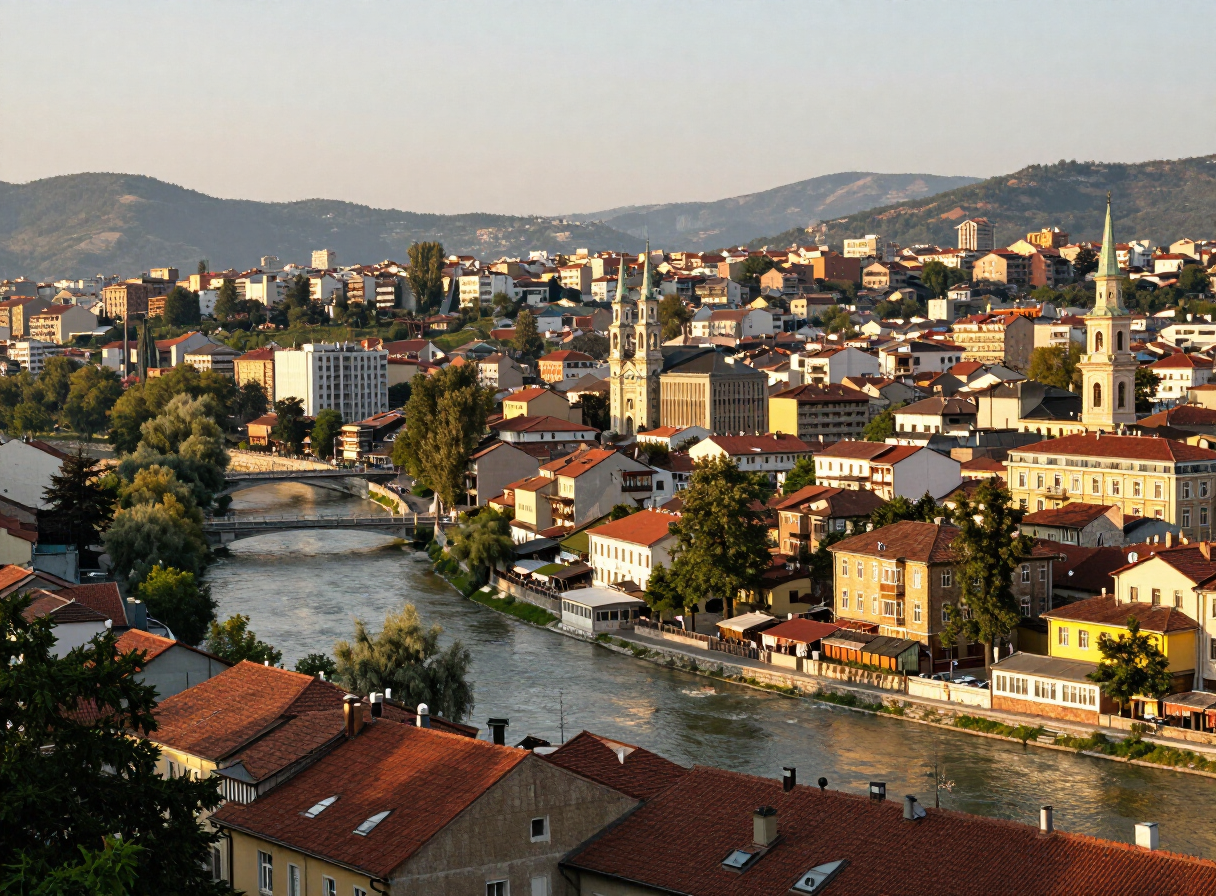
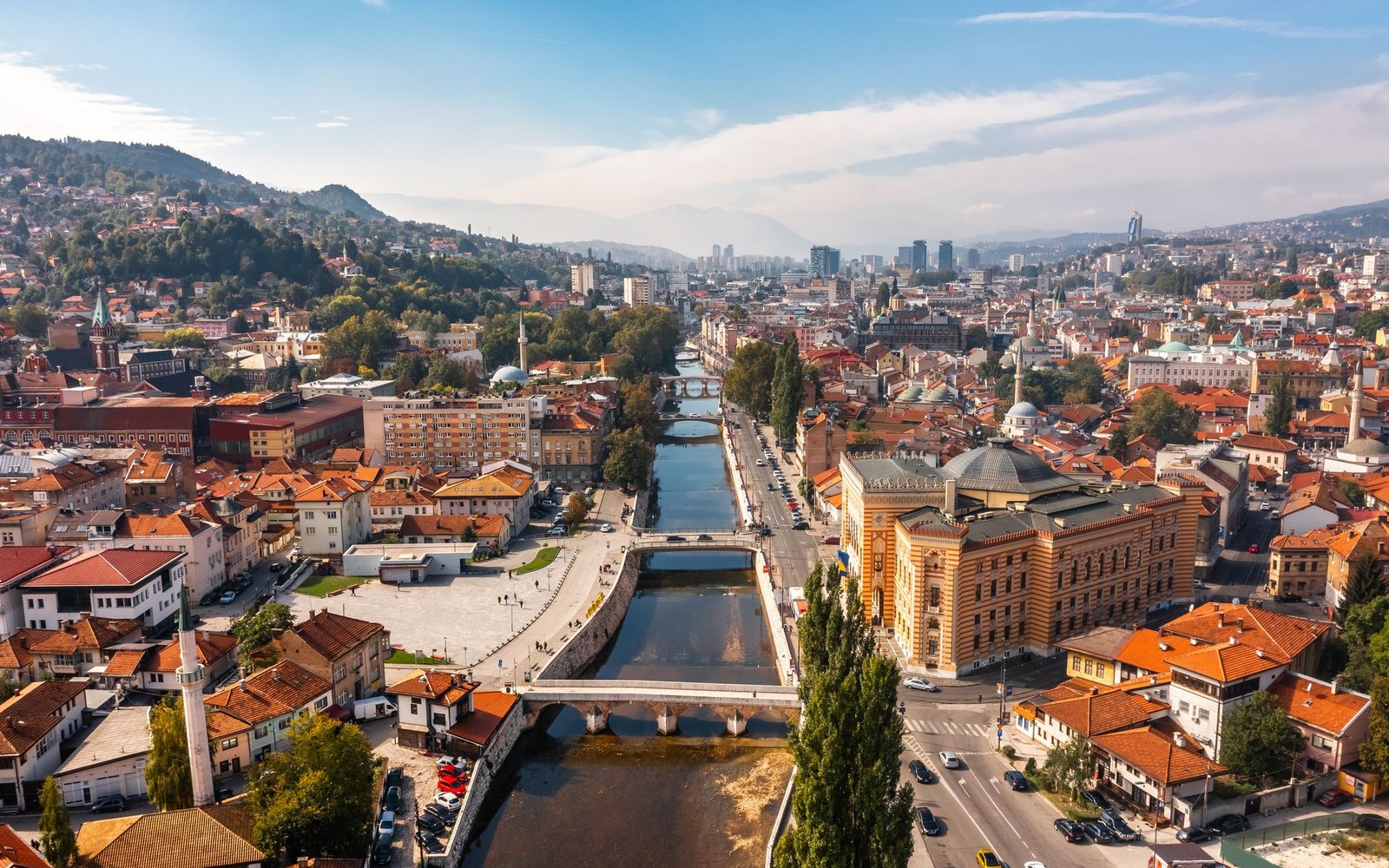
The Miljacka embankments run east and west from the bridge and are one of the pleasantest walks in the city, especially toward dusk. The river is hemmed by the hills on both sides, and the minarets, church towers and Habsburg façades rise above the embankments in a single skyline. The walk from the Latin Bridge toward the old town is short; the walk west toward the modern centre passes several of the city’s bridges and gives the clearest sense of how Sarajevo is folded into its valley.
Where the urban layers meet
The line where Ottoman Sarajevo meets Austro-Hungarian Sarajevo is the most telling single thing about the city, and it is crossed on foot without ceremony. Ferhadija, the pedestrian street that runs west from Baščaršija, is the seam: the stone lanes and low shopfronts of the bazaar give way, within a few hundred metres, to the Secessionist façades and wider avenues of the Habsburg period. Few capitals pack two such different urban worlds into such a short walk.
The Habsburg layer brought the tram system, the pseudo-Moorish buildings that line the river, and the Latin Bridge’s present shape, and it set the commercial centre of gravity westward, which is why modern Sarajevo has an Ottoman east and a Habsburg west. The marks of the 20th century are here too — the siege of the 1990s left scars on the buildings that have been deliberately kept visible in places, and the city’s recent history is read alongside its older one rather than hidden beneath it.
For a visitor, the value of this stretch is that it makes the city legible in an afternoon. Walk Ferhadija from the Sebilj to the modern centre, and the founding identity of Sarajevo — a border town between empires and faiths — is visible in the architecture on both sides of the street.
End above the city
The best way to close a day in Sarajevo is to climb above it. The hills that hem the valley hold several viewpoints, and the Yellow Bastion is the classic one — a fortified terrace above the old town that gives the panorama of the city laid out in the valley below, the minarets and church towers catching the last light, and the hills darkening on the far side of the Miljacka.
Arrive in the hour before sunset and stay until the lights come on. The city turns gold, then pink, then the lanterns of Baščaršija and the embankments begin to glow, and the call to prayer and the church bells cross the same air one more time. The view is the reason Sarajevo is one of the most photographed capitals in the Balkans, and the climb is the way to understand why the city feels the way it does — folded into a valley, watched over by hills, and lit from above at dusk.
Bring a layer for the evening; the hills are cooler than the valley, and the best of the light comes as the temperature drops. The walk back down into Baščaršija for a late ćevapi or a final coffee is the natural end to the day, and the bazaar is at its most atmospheric after the crowds thin.
Practical notes for one day in Sarajevo
- Suggested time
- A single full day covers Baščaršija, the Latin Bridge and the Ferhadija seam; an evening climb to the Yellow Bastion rounds it off.
- Best season
- Spring and autumn for mild weather and clear light on the hills; summer is warm and busy, winter is cold and quiet with snow on the surrounding mountains.
- Getting around
- The core is compact and walkable; the tram runs along the valley for longer moves, and the hills are reached on foot or by taxi.
- Responsible travel
- Respect places of worship, support the craftsmen of the bazaar rather than the souvenir stalls, and confirm current access to viewpoints locally.
THROUGH THE LENS
From the road


RELATED DESTINATIONS
Places in this story
ATTRACTIONS IN THIS STORY
10 attractions
Baščaršija & Sebilj
The Ottoman old bazaar and its wooden fountain — the soul of the city.
Latin Bridge
Site of the 1914 assassination that ignited the First World War.
Vijećnica
The neo-Moorish City Hall, destroyed in 1992 and gloriously rebuilt.
Gazi Husrev-beg Mosque
The 16th-century heart of Ottoman Sarajevo.
Tunnel of Hope
The lifeline tunnel of the siege — a moving, essential museum.
Trebević Cable Car
From the old town to mountain viewpoints in ten minutes.
National Museum of Bosnia and Herzegovina
Founded in 1888, the country’s oldest museum — archaeology, ethnology, natural history and the Sarajevo Haggadah.
War Childhood Museum
Personal objects and first-person stories of childhood affected by war, opened in Sarajevo in January 2017.
THINGS TO DO
Experiences Not to Miss
Eat ćevapi where locals queue for them
Walk the Miljacka embankments at dusk
Hear the stories of the siege from a local guide
Walk from Baščaršija to the Austro-Hungarian centre
Bosnian coffee, the slow way
INTERESTS
Explore by what you love
ROUTES
Routes through here
Mostar to Sarajevo via the Neretva Canyon
A classic Balkan ride north up the Neretva canyon — river, cliffs and forest from Mostar to Sarajevo.
130 km · 3 h · moderate
VIEW ROUTETrebević Summit from Pogledine
An out-and-back ascent from Pogledine past Trebević’s Olympic bobsleigh track and forest paths to the Sofe summit area above Sarajevo.
15.8 km · 5.8 h · moderate
VIEW ROUTESkakavac Waterfall Loop
A forest loop from the Skakavac protected-area entrance to the viewpoint and foot of Sarajevo’s 98-metre waterfall.
9.2 km · 3.9 h · moderate
VIEW ROUTEMORE TO EXPLORE
Keep exploring
The road goes on — more destinations, stories and road trips from every corner of the world.