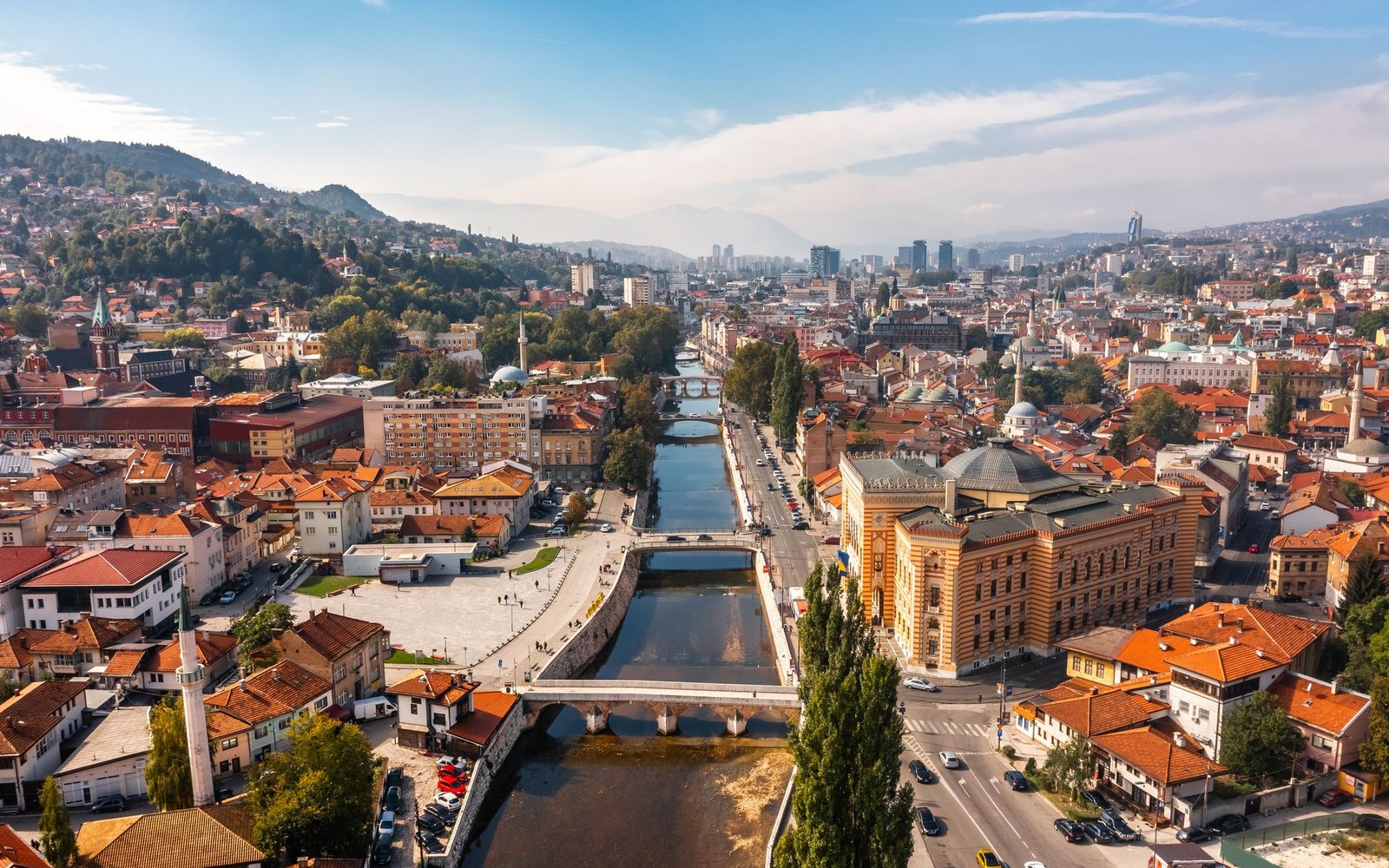
Sarajevo is the capital and transport hub of Bosnia & Herzegovina. Its international airport lies a short drive from the city centre — confirm current transfer options (bus, taxi) locally rather than relying on fixed schedules. Intercity buses link the city with Mostar, Banja Luka, Višegrad and the Adriatic coast, and the Sarajevo–Ploče train runs south through the Neretva canyon to Mostar and Čapljina. Within the city, a single tram line follows the Miljacka from Baščaršija westward through the Austro-Hungarian centre, and a network of buses and minibuses reaches the hillside neighbourhoods; the old town itself is compact and best explored on foot.
Getting around is simple once you understand the geography: the tram line is the spine of the city, running along the flat valley from the old town westward, with buses and minibuses covering the hills on either side — buy tram tickets at kiosks before boarding rather than on board. Almost everything a visitor comes to see sits in the walkable strip between Baščaršija and the Austro-Hungarian centre, so most of the city is done on foot. Taxis are useful for the airport, the Tunnel of Hope museum in Butmir and Ilidža at the western end of the tram line; check current public-transport arrangements locally, as routes and schedules change.
Weather shifts quickly with the valley and the mountains around it. May to June and September are mild and the most comfortable for walking; July and August are warm and busiest; December to February are cold, short on daylight and put snow on Trebević and the Olympic mountains. Whatever the season, check the day’s forecast before setting out — the mountains change the weather fast — and check current access to each sight directly before visiting, as opening hours and arrangements vary through the year.
Shoes with grip matter more than anything else — the cobbled lanes of Baščaršija and the stone of the bridges are worn smooth and slippery when wet, and the hills above the city are steep. Carry some cash (BAM), since bazaar stalls, bakeries and smaller cafés often prefer cash. Dress modestly if you plan to enter mosques or churches (shoulders and knees covered; scarves are usually provided at mosque entrances), behave respectfully at religious sites and at the memorials scattered through the city, and bring a layer for the mountains — Trebević and Jahorina are noticeably cooler than the valley.
The flat central valley along the Miljacka and the Austro-Hungarian grid is largely level and paved, and the tram runs along it. Baščaršija is flat in outline but paved in worn stone cobbles, which makes wheelchair and pushchair access difficult on many lanes. The Gazi Husrev-beg Mosque minaret is reached by a narrow, steep staircase, and the Trebević cable car upper station and the bobsled track below the ridge involve steps and uneven paths. The Tunnel of Hope museum in Butmir is reached by taxi or vehicle and has step access at the entrance. Many older buildings have limited or no step-free access — check directly with each site before visiting.