THINGS TO DO
Climb to the fortress tower for the view over the village and the Neretva
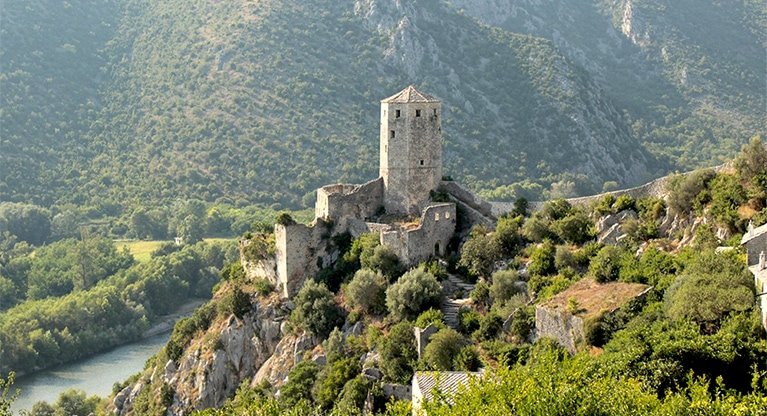
The ascent of the steep stone lanes to the Kula tower on the summit, for the panorama over the stone amphitheatre of Počitelj and the Neretva plain below.
History & Heritage
A medieval-Ottoman fortified village on the Neretva — a stone amphitheatre of a town climbing to a hilltop fortress, on the UNESCO Tentative List since 2007.
Počitelj is a historic fortified village on the left bank of the Neretva river in Herzegovina, between Mostar and the Čapljina plain. It is built into the side of a steep hill in the form of a stone amphitheatre, with houses, a mosque and a clock tower climbing the slope to a medieval fortress on the summit. The first documented reference to Počitelj dates from 1444, and a local tradition attributes the initial fortress to King Tvrtko I in 1383 — a plausible but unproven founding date rather than a documented one. The settlement fell under Ottoman control in 1471, and its surviving urban ensemble developed principally from the 16th to the 18th centuries. Počitelj guarded the Neretva crossing on the road from the sea to the interior, and its surviving fabric — the fortress, the Šišman Ibrahim-paša (Hadži Alija) Mosque, the sahat-kula clock tower and the old stone houses — makes it one of the most complete Ottoman-period ensembles in the country. It has been on the UNESCO Tentative List since 2007 and has hosted an art colony since the 1960s. For a visitor it is a single, walkable hillside — a place to climb, to photograph and to read the layered medieval and Ottoman past of Herzegovina.
MAP & LOCATION
THROUGH THE LENS


HISTORY & CULTURE
The first documented reference to Počitelj dates from 1444, and a local tradition attributes the initial fortress to King Tvrtko I in 1383 — an assumption rather than a proven founding date. The settlement fell under Ottoman control in 1471, and it was developed as a garrison town guarding the Neretva crossing on the road from the Adriatic to the interior. Its surviving urban ensemble developed principally from the 16th to the 18th centuries: the fortress with its Kula tower, the Šišman Ibrahim-paša (Hadži Alija) Mosque built in 1562–63, the sahat-kula clock tower and the stone houses that climb the hillside. In the 1960s an art colony was established in the village, adapting the Gavrankapetanović residential complex for artists’ use from 1961 with the conversion completed in the 1970s, helping to keep its buildings in use. The mosque and other buildings suffered damage during the 1990s conflict and were restored in the post-war period. Počitelj has been on the UNESCO Tentative List since 2007.
TOP THINGS TO DO
TOP ATTRACTIONS
FOOD & DRINK
Simple Herzegovinian fare in the small cafés and konobas around the lower settlement — grilled meat, pies and Bosnian coffee
River fish — trout prepared simply, a specialty of the Herzegovinian rivers, where available locally
Bosnian coffee served the slow way, the natural pause on any visit to the village
Nearby Čapljina and Mostar offer a wider choice of restaurants for a sit-down meal before or after a visit
HOTELS & STAYS
Počitelj has limited local accommodation compared with Mostar or Čapljina; most visitors come on a day trip
A small number of guesthouses and restored stone houses in and around the village may be available — check current options locally
Mostar, about half an hour away, is the practical base for a visit, with the widest range of hotels and guesthouses
Čapljina, the nearest larger town, offers additional accommodation and is convenient for combining Počitelj with Kravica and Međugorje
SEASONS
Year-round stone village — spring and autumn give the clearest light with fewest crowds; mornings always best.
PLAN YOUR VISIT
Počitelj sits directly on the Mostar–Čapljina road (M17) on the left bank of the Neretva, about 30 km from Mostar and a short drive from Čapljina. By car it is an easy stop between Mostar and the coast; buses on the Mostar–Čapljina route may stop nearby — check current timetables before you travel, as services and schedules can change. The viewpoint from across the Neretva is reached from the road on the opposite bank.
Sturdy shoes with grip for the steep, uneven stone lanes and stairs; a hat and water for the exposed climb in warm weather; modest clothing for the mosque (shoulders and knees covered, scarves available at the entrance); and some cash (BAM), as small cafés and any local stalls often prefer cash.
The lower settlement is relatively flat, but the lanes are uneven stone and the climb to the fortress is steep, with stairs and little shade — the upper hillside and the fortress route are not accessible to wheelchair users or visitors with limited mobility. The cross-river viewpoint is reachable from the road on the opposite bank with less effort. Assess each part of the village against your needs and check current access locally before a dedicated visit.
NEARBY ESSENTIALS
Practical services and stops along the way — fuel, food, parking, campsites, medical and motorcycle services. Listings are compiled from published sources; confirm current opening dates, prices and facilities directly with each operator.
TC Robot Čapljina
2.5 kmSupermarket
Supermarket for self-catering in pocitelj.
Sources checked: 6 Nov 2026
Sparkassen
3.3 kmATM / Cash
Cash point for pocitelj — BiH is still a cash-heavy country, carry marks (KM/BAM).
Sources checked: 6 Nov 2026
WEATHER
Forecast data from Open-Meteo. Updated regularly.
NEARBY DESTINATIONS
INTERESTS
REGIONS
COUNTRIES
MORE TO EXPLORE
The atlas goes on — more destinations, stories and road trips from every corner of the world.