THINGS TO DO
Listen to the Sea Organ at Sunset
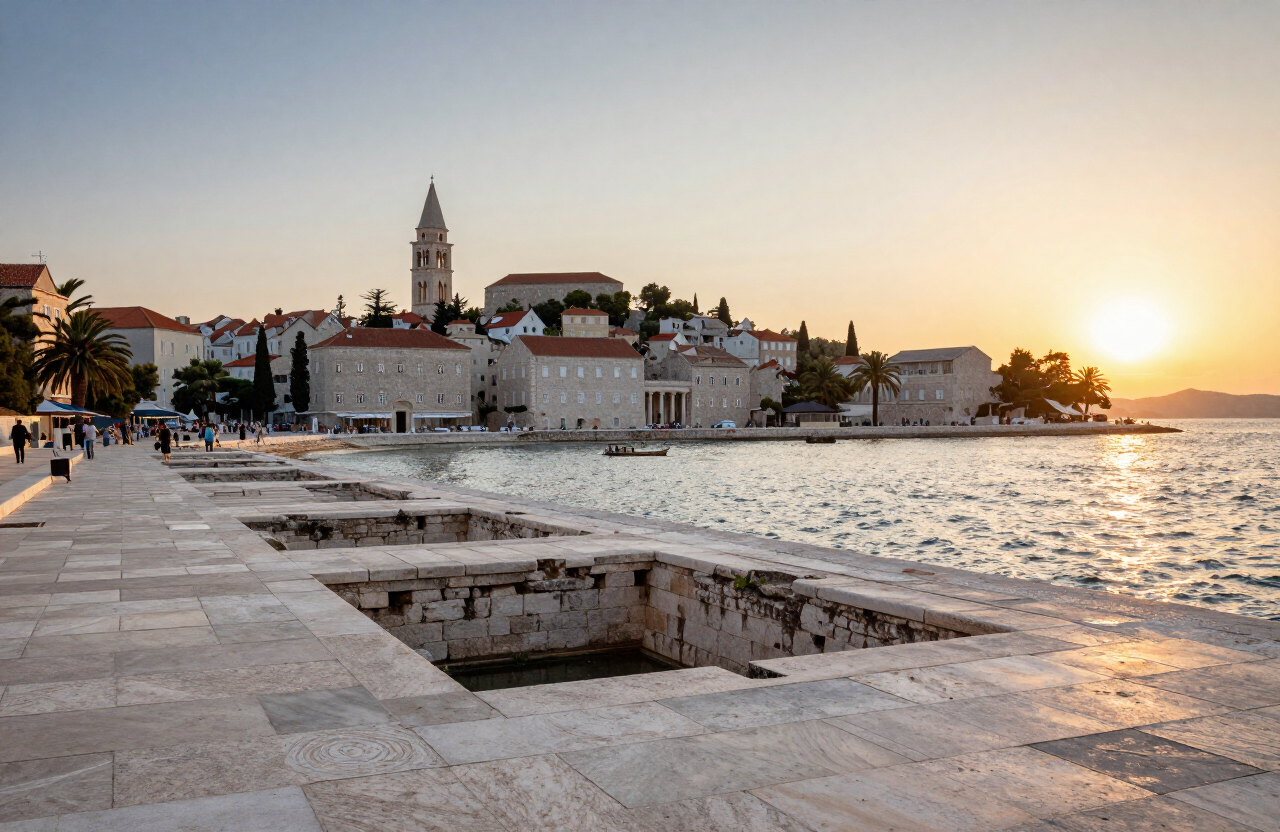
Sit on the Sea Organ steps at sunset and listen to the music the waves play through the waterfront.
Zadar is the historic capital of Northern Dalmatia, a compact old town on a peninsula laid out on its original Roman street grid and crowded with Romanesque churches, Roman ruins and a Venetian harbour wall. Its modern signature is the Sea Organ, which plays with the waves, and the Monument to the Sun, a glass installation that catches the sunset for which the city is famous — a rare blend of ancient stones and contemporary art on the same waterfront.
MAP & LOCATION
THROUGH THE LENS
HISTORY & CULTURE
Zadar was a Roman colony (Iader) whose street grid still underlies the old town, and it became the capital of Byzantine Dalmatia before passing to Venice, which left the harbour walls and the Venetian gates. Heavily bombed in World War II, it was rebuilt and joined Croatia after independence, and its Sea Organ and Monument to the Sun have made its waterfront a modern landmark that sits, remarkably, beside the Roman forum.
TOP THINGS TO DO
TOP ATTRACTIONS
FOOD & DRINK
Restaurant Pet Bunara — Dalmatian cooking near the market
Old-town konobas and waterfront cafés
HOTELS & STAYS
Hotel Bastion — boutique hotel in the old town
Old-town apartments near the Sea Organ
ITINERARIES
NATURE & WILDLIFE
Zadar’s nature is the sea and the islands. The old-town peninsula is surrounded by the harbour and the open water where the sun sets, and the offshore Kornati archipelago — a maze of uninhabited karst islands — is the great natural sight within reach, reached by boat from Zadar. To the north, the salt lagoon of Nin and the Velebit mountains behind Paklenica give the region a coast-and-mountains range, and the Krka river to the south adds waterfalls and river habitat to the marine one. Dolphins are occasionally seen in the channel off the city.
PLAN YOUR VISIT
Zadar has its own airport with seasonal European flights, about 20 minutes from the centre. By car it is about 2.5 hours from Zagreb via the A1 motorway, and 1 hour from Plitvice. Direct buses run from Zagreb, Split and Rijeka, and ferries connect Zadar to the Kvarner islands and the Kornati.
The old town is pedestrianised and walkable; the surrounding coast and Nin need a car or bus, and the islands are reached by ferry from the harbour.
One day covers the old town and the Sea Organ at sunset. A second day adds Nin, the coast or a boat trip to the Kornati.
May–June and September for warm weather and fewer crowds; July and August for swimming and the busiest sunset season.
WEATHER
Forecast data from Open-Meteo. Updated regularly.
TRAVEL GUIDES · STORIES
More here soon — the road is still being mapped.
NEARBY DESTINATIONS
INTERESTS
REGIONS
COUNTRIES
MORE TO EXPLORE
The atlas goes on — more destinations, stories and road trips from every corner of the world.