MAGAZINE STORY · Road Trips
A Road Trip Through Herzegovina — Mostar, Blagaj, Počitelj and Stolac
Four historic places, one river landscape and a journey through the stone towns, karst springs and layered heritage of southern Bosnia and Herzegovina.
THE STORY
Four historic places, one river landscape and a journey through the stone towns, karst springs and layered heritage of southern Bosnia and Herzegovina.
- Published
- September 23, 2026
- Read time
- 9 min read
Begin where the Neretva divides Mostar
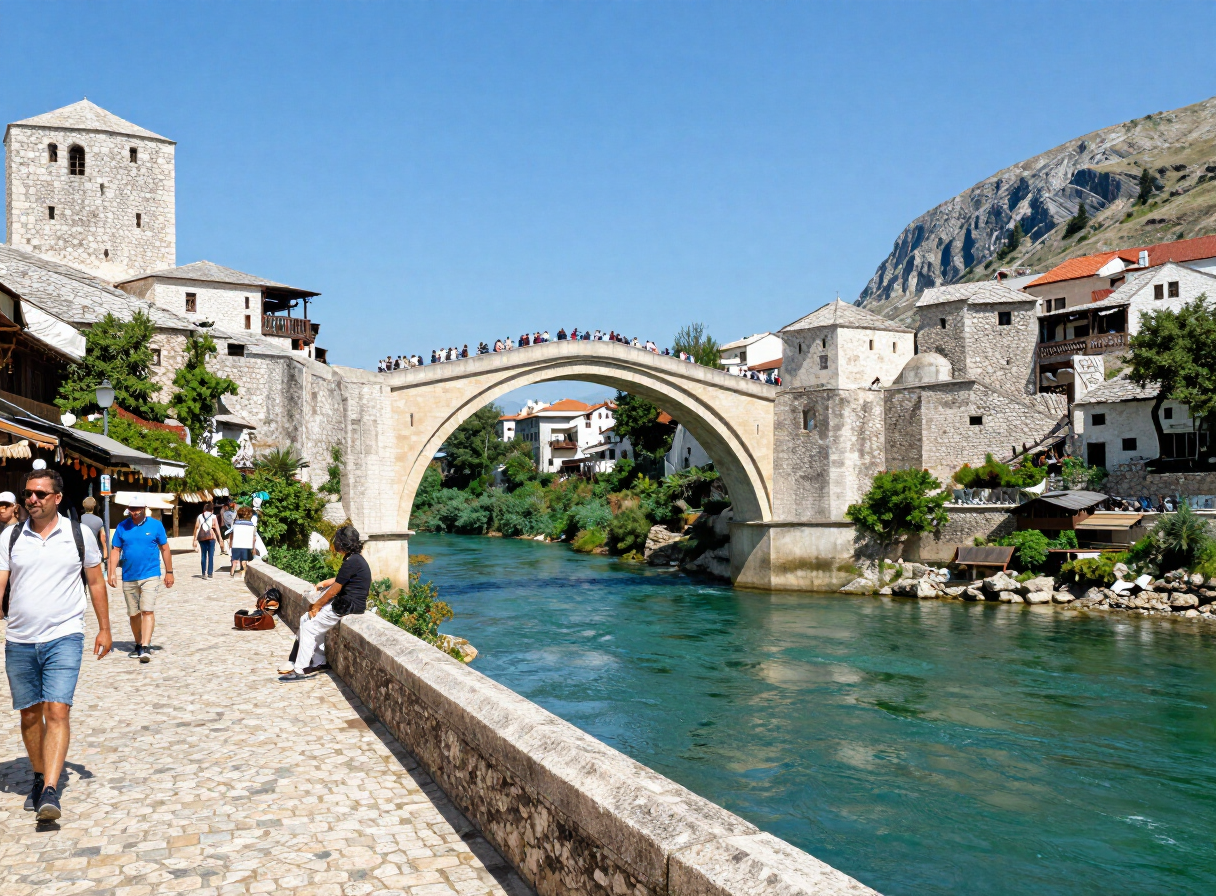
Mostar is the natural starting point for a journey through Herzegovina, and the place to begin is the bridge that gives the city its name. Stari Most — the Old Bridge — is the slender stone arch that Suleiman the Magnificent ordered across the Neretva in the 1560s, a single span of pale limestone rising to a sharp crest with no parapet. Destroyed in the war in 1993 and rebuilt with stone lifted from the riverbed, it reopened in 2004 and now stands at the heart of a UNESCO World Heritage Site.
The bridge joins a Muslim quarter on the east bank to a Christian one on the west, and the old bazaar of Kujundžiluk tumbles down the east bank to its feet. The coppersmiths whose guild gave the street its name still hammer coffee sets and trays by hand in low workshops, and the call to prayer and church bells cross the same air. From late spring through early autumn, trained local divers leap from the bridge’s apex into the emerald water below — a tradition documented for generations, and one that visitors should watch, never attempt.
Mostar compresses Ottoman heritage, wartime memory and the Herzegovinian landscape into a walkable space, and it sets the themes for the whole road trip: stone, water, and a past layered in plain sight. Spend the first morning on the bridge and in the bazaar before the heat and the crowds build, then head south into the karst.
Follow the karst water to Blagaj
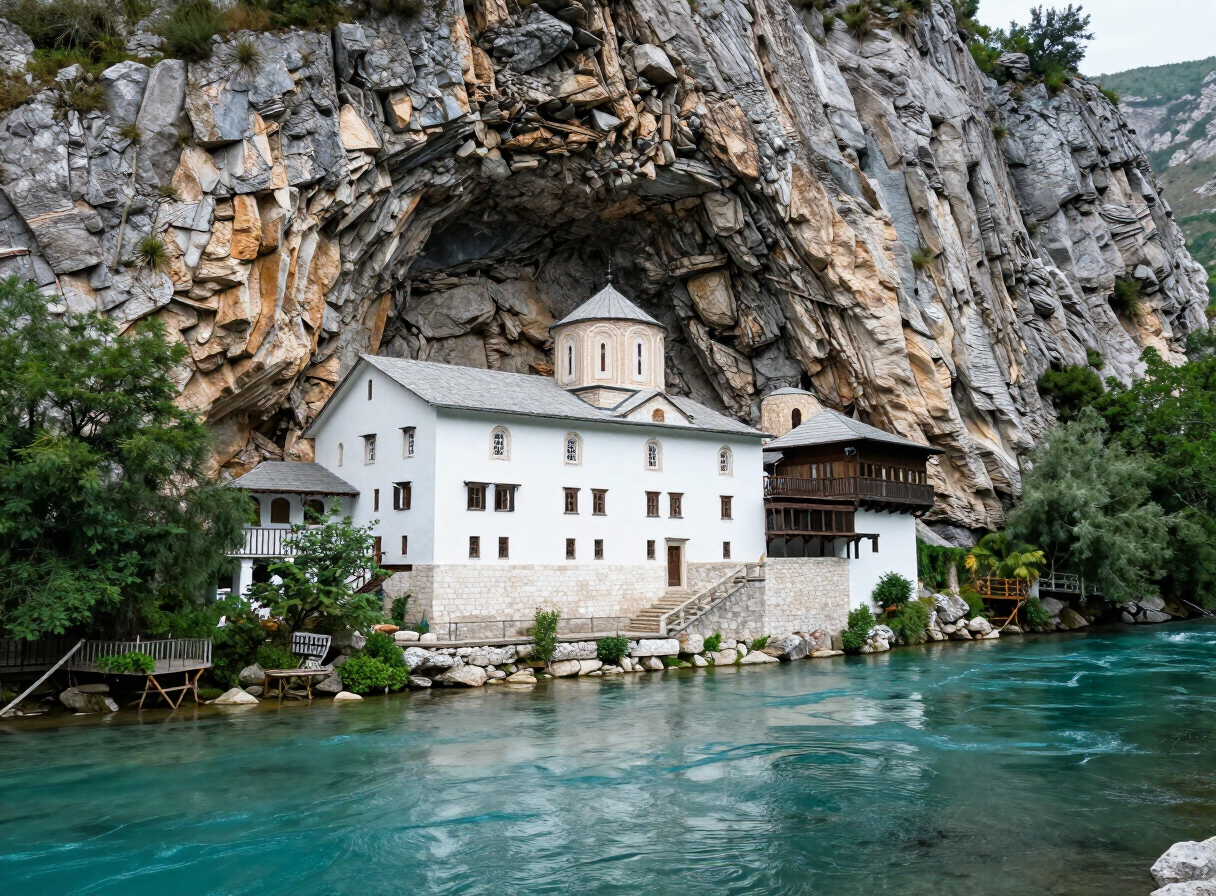
A short way southeast of Mostar, the Buna river appears at once from the base of a sheer limestone cliff. The Buna spring, Vrelo Bune, is a major karst resurgence — the point where water collected in the uplands behind Blagaj re-emerges as a full river — and the sight of a substantial river emerging from the rock is the reason the site became a place of settlement and worship.
At the mouth of the spring stands the Blagaj tekija, a Dervish monastery established around 1520 that combines Ottoman and Mediterranean architectural elements. Its stone walls and wooden galleries sit against the cliff beside the water, and it remains an active place of worship and pilgrimage. Above the village, on the hilltop, lie the ruins of Stjepan-grad, the medieval fortified seat associated with the Kosača lords and the capital of Herzegovina under Stjepan Vukčić Kosača in the 15th century.
The natural and architectural ensemble of the spring, the cliff and the tekija is on the UNESCO Tentative List — a candidate for inscription rather than an inscribed site. Blagaj compresses the themes of Herzegovina — water, karst, Ottoman faith and medieval power — into a single compact site beside the Buna, and it is the easiest detour from Mostar on this route.
Climb through the stone town of Počitelj
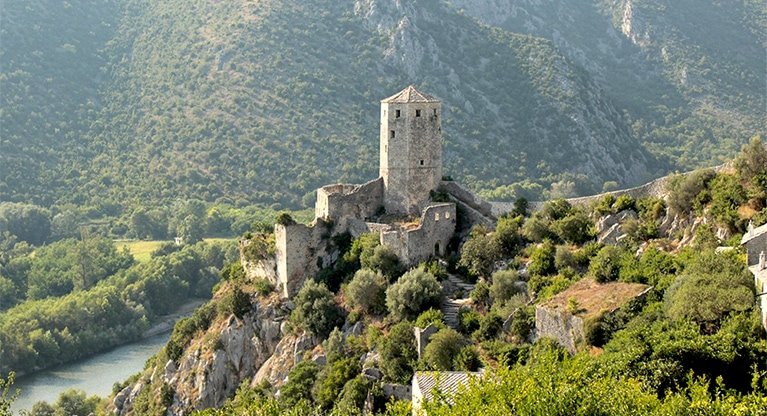
Down the Neretva from Mostar, Počitelj is a historic fortified village built into the side of a steep hill in the form of a stone amphitheatre. Houses, a mosque and a clock tower climb the slope to a medieval fortress on the summit, and the first documented reference to the settlement dates from 1444. The settlement fell under Ottoman control in 1471, and its surviving urban ensemble developed principally from the 16th to the 18th centuries.
Počitelj guarded the Neretva crossing on the road from the sea to the interior, and its surviving fabric — the fortress, the Šišman Ibrahim-paša (Hadži Alija) Mosque, the sahat-kula clock tower and the old stone houses — makes it one of the most complete Ottoman-period ensembles in the country. It has been on the UNESCO Tentative List since 2007 and has hosted an art colony since the 1960s.
The town is a single, walkable hillside. The reward for the climb is the view back over the Neretva and the stone roofs stacked below, and the sense of a place that was built to be defended and is now preserved to be read. Počitelj is the most photographed stop after Mostar on this route, and it earns the attention.
End beside the Bregava in Stolac
Stolac is a small heritage town in the karst of eastern Herzegovina, set on the Bregava river. The Stolac area preserves evidence from prehistoric, Illyrian, Roman, medieval, Ottoman and later periods, and the town reads as a layered sequence: a hilltop fortress — Vidoški grad — watches over a medieval and Ottoman stone town of mosques, a clock tower and the Begovina complex.
Just outside the town lies Radimlja, one of the finest and most richly decorated necropolises of stećci, the medieval tombstones of Bosnia and Herzegovina. Radimlja is a component of the UNESCO-inscribed transnational serial property “Stećci Medieval Tombstone Graveyards”, inscribed in 2016. The wider historic ensemble of Stolac is protected as a national monument rather than an inscribed UNESCO World Heritage Site.
Stolac is the quietest and most concentrated heritage stop on the route, a counterpart to Počitelj and Mostar where the layers sit closer together and the crowds thin. End the day beside the Bregava, where the river and the stone make the case for Stolac on their own.
Plan the journey as a two-day route
The four towns link naturally along the Neretva and Bregava valleys, and the route reads best as a two-day journey rather than a single long dash. Mostar anchors the first day; Blagaj, Počitelj and Stolac fill the second, each a short move down the valley from the last.
- Mostar first — give the bridge and the bazaar a full morning before the heat and the crowds build.
- Blagaj as a detour — the spring and the tekija are the easiest addition from Mostar, and the cliff is at its best in morning light.
- Počitelj and Stolac together — both are hillside stone towns, and they pair well on a single day down the valley.
- Check access locally — opening times at the tekija and conditions at heritage sites vary; confirm before you set out.
Practical notes for the Herzegovina road trip
- Suggested time
- Two days let the four towns breathe; a single long day reaches them but rushes each.
- Best season
- Spring and autumn for mild weather and clear light on the stone; summer is hot and busy at the bridge.
- Getting around
- A car is the practical way to link the four towns; the route follows the Neretva and Bregava valleys.
- Responsible travel
- Respect places of worship, stay on marked paths at heritage sites, and confirm current access locally.
THROUGH THE LENS
From the road


RELATED DESTINATIONS
Places in this story
Mostar
The Ottoman bridge town on the emerald Neretva.
Herzegovina
Blagaj
A village at the Buna spring — where a powerful karst river bursts from a cliff beneath a Dervish tekija and a medieval fortress crowns the hill above.
Herzegovina
Počitelj
A medieval-Ottoman fortified village on the Neretva — a stone amphitheatre of a town climbing to a hilltop fortress, on the UNESCO Tentative List since 2007.
Herzegovina

Stolac
A heritage town in the Herzegovina karst — a hilltop fortress, a UNESCO stećci necropolis and an old stone quarter on the Bregava river.
Herzegovina
ATTRACTIONS IN THIS STORY
23 attractions
Stari Most
The stone arch thrown across the Neretva by order of Suleiman the Magnificent and completed in the 1560s — a single 29-metre span that gave the city its name and its symbol. Destroyed in November 1993, the bridge was rebuilt with stone hauled from the riverbed and reopened in 2004; the old bridge area is now a UNESCO World Heritage Site. Each summer trained local divers leap from its apex into the emerald water twenty-four metres below.
Kujundžiluk
The coppersmiths’ quarter that tumbles down the east bank to the bridge — a lane of Ottoman workshops where kujundži still hammer coffee sets and trays by hand. The cobblestones, overhanging eaves and tiny shops are largely unchanged since the 16th century, and the street is the living heart of the old town.
Koski Mehmed Pasha Mosque
A single-domed mosque built in 1617–18 by Koski Mehmed Pasha, set a few steps from the bridge with its courtyard almost overhanging the Neretva. Visitors can climb the narrow minaret stair for the most photographed view of Stari Most and the river gorge — the classic Mostar panorama.
Kriva Ćuprija
A smaller, older Ottoman stone bridge spanning the Radobolja creek a few minutes’ walk north of Stari Most. Built before its famous neighbour, it is often read as its prototype — a single humpbacked arch that survived the war intact and now sits quietly among the old houses.
Muslibegović House
A well-preserved late-Ottoman residential complex on the west side of the old town, one of the finest surviving examples of Mostar’s traditional stone-and-wood domestic architecture. Now a house-museum and heritage hotel, it shows how a wealthy Muslim family lived — carved ceilings, separate selamluk and haremluk quarters, and a shaded inner courtyard.
Museum of the Old Bridge
Housed in the 15th-century Tara (Herceguša) tower at the bridge’s west end, the museum traces the bridge’s Ottoman construction, its 1993 destruction and the 2004 reconstruction. Displays include original stone fragments recovered from the river, archival plans and the story of the divers who keep the jumping tradition alive.
Karađoz-beg Mosque
The largest Ottoman mosque in Herzegovina, built in the 1550s by Karađoz-beg, the great benefactor of 16th-century Mostar — a domed mosque with a slender minaret, once the centre of a complex that included a madrasa, a hamam and a clock tower.
Fortica Viewpoint and Adventure Park
A hilltop viewpoint and outdoor-adventure area on the slopes of Fortica, east of Mostar, around the 500-metre elevation level. From its terraces and glass skywalk it offers a broad panorama over Mostar, the Neretva valley and the surrounding Herzegovinian landscape, with separate zipline and climbing or adventure facilities whose access, operation and suitability must be confirmed locally.
THINGS TO DO
Experiences Not to Miss
Watch the local divers leap 24 metres from Stari Most
Drink Bosnian coffee the slow way in the old bazaar
Catch sunset over the bridge from Lučki most
Fortica Panorama and Skywalk Visit
Mostar Austro-Hungarian Architecture Walk
Visit the tekija at the Buna spring and walk the riverbank beneath the cliff
Hike up to the ruins of Stjepan-grad fortress for the view over Blagaj and the Buna valley
See the Buna spring where the river emerges from the rock
RELATED GUIDES
Practical guides
MORE STORIES
Keep reading

ROUTES
Routes through here
Mostar to Sarajevo via the Neretva Canyon
A classic Balkan ride north up the Neretva canyon — river, cliffs and forest from Mostar to Sarajevo.
130 km · 3 h · moderate
VIEW ROUTEBogodol–Velika Vlajna Summit Route
A demanding out-and-back ascent from Bogodol to Velika Vlajna, the high point of the bare Čabulja massif northwest of Mostar.
12 km · 4.8 h · challenging
VIEW ROUTEMORE TO EXPLORE
Keep exploring
The road goes on — more destinations, stories and road trips from every corner of the world.